
User research is important for UX designers who aim to create products that resonate with real users. But with so many user research methods out there, it can be overwhelming to know where to start.
Each method has its strengths and weaknesses, and knowing when to use one over the other is key to gaining valuable insights.
This article explores several common user research methods, helping you understand the options and when to apply them.
TLDR – Key Takeaways
- User research is essential for effective UX design, helping teams move from assumptions to evidence-based decisions.
- Different research methods serve different purposes — qualitative methods explain why users behave a certain way, while quantitative methods show how often patterns occur.
- Timing matters: conducting research early (and continuously) is significantly cheaper and more impactful than fixing issues after launch.
- There is no single “best” user research method — the right choice depends on your goals, product stage, timeline, and resources.
- Combining multiple research approaches (attitudinal + behavioral, generative + evaluative) leads to more reliable and actionable insights.
- User research should be an ongoing process, not a one-off activity tied only to major releases.
- Well-structured user research improves usability, reduces risk, and increases product success, while aligning teams around real user needs.
What Is User Research in UX Design?
User research is an essential part of UX design, which involves systematically investigating how users behave, what they need, and what motivates them. Researchers usually gather this information using a combination of methods.
The insights gained from this research are critical because they inform design decisions, helping to ensure your product meets user expectations and effectively solves their problems.
The primary goal of user research is to build empathy and create services and experiences that add value to our users. By focusing on usability, functionality, and overall user satisfaction, designers can create intuitive and enjoyable experiences for the end user.
Research provides an understanding of what users do and, more importantly, why they do it. This helps you find pain points, define user goals, and map out workflows that make sense for the people using your product.
User research isn’t something you do just once. It’s an ongoing process, applied at various stages of the product development process . Whether you’re in the discovery phase, testing prototypes, or making post-launch improvements, research remains valuable throughout the process.
There are many different user research methods available, each offering unique insights. In the following sections, you’ll learn more about these methods and how to apply them effectively in your user-centered design process.
User research provides teams with situational awareness about what users do and why they do it. It is the compass for making effective and objective design decisions.
The 1-10-100 Rule and Its Role in User Research
The 1-10-100 rule illustrates how the cost of fixing problems increases the later they are discovered:
| Stage of Discovery | Relative Cost | UX Impact |
|---|---|---|
| Design phase | 1× | Easy to fix design issues early |
| Development phase | 10× | More costly rework/staff time |
| After launch | 100× | High user churn and expense |
In UX design, this rule highlights why early user research is critical. Research conducted before and during design helps teams identify usability issues, misunderstandings, and unmet needs while changes are still inexpensive.
Involving users early reduces rework, lowers risk, and prevents costly fixes after release.
Key Benefits of User Research for UX Teams
- Reduces guesswork with data-driven insights
- Boosts usability by uncovering user pain points
- Fosters empathy for user goals and frustrations
- Drives innovation through unmet need discovery
- Reduces design risks early
- Aligns cross-functional teams
User research is important for UX teams to make informed decisions and create designs that genuinely meet user needs. It provides data-driven insights, which help reduce guesswork and assumptions. With concrete data, you can base design choices on real user feedback instead of vague hunches.
User research enhances usability by identifying pain points, enabling the creation of more user-friendly interfaces that improve interactions and overall experience. It fosters empathy by providing insights into user goals, frustrations, and behaviors, enabling you to design with the user’s perspective and needs in mind.

In addition, user research can drive innovation. Finding unmet user needs often sparks creative solutions that might not have been immediately obvious. It opens up new possibilities for features or designs that can set your product apart from the competition.
Reduced design risks are another critical outcome of user research. By identifying potential issues early in the process, you can address them before they become costly problems in later development stages, saving time and resources.
Finally, user research helps align cross-functional teams—from designers and developers to product managers and marketers—around a shared understanding of user priorities. This unified approach leads to more cohesive products.
Categories of User Research Methods
Qualitative vs. Quantitative
Qualitative research focuses on understanding why users behave in a certain way by learning about their motivations, experiences, and emotions through non-numerical data. Some common qualitative methods include:
- Interviews: One-on-one conversations to dig into users’ thoughts and feelings.
- Diary studies: Letting users keep a log of their thoughts, actions and experiences over a pre-defined period of time.
- Open-ended questions: Encouraging users to describe their experiences in their own words.
Qualitative research provides rich, contextual insights, helping you understand the deeper reasons behind user actions.
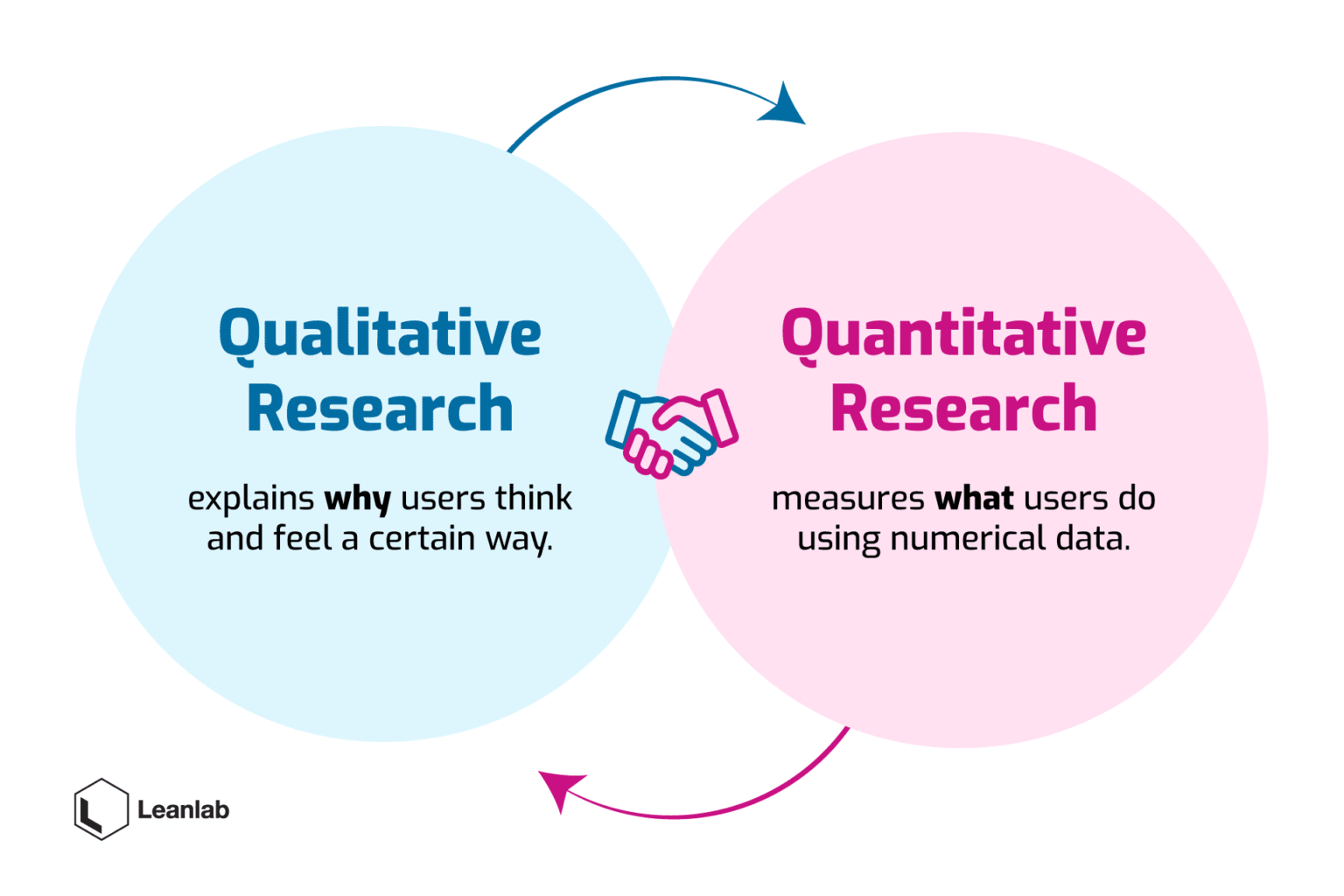
In contrast, quantitative research measures what is happening by analyzing numerical data. It’s about tracking patterns and trends. Typical quantitative methods include:
- Surveys: Collecting responses from a large group of users.
- Preference Testing: Asking users to choose between multiple designs or features to determine overall preferences.
Quantitative research helps you identify trends and general user behavior but doesn’t explain why those behaviors occur.
Combine both qualitative and quantitative methods for a holistic understanding of user behavior. Together, they offer a full picture—the what and the why.
Use qualitative and quantitative research to understand user behavior deeply and broadly.
| Category | Focus | Representative Methods | Typical Use Case |
|---|---|---|---|
| Qualitative | Why & how users think/feel | Interviews, diary studies | Discovery & empathy |
| Quantitative | Numeric patterns | Surveys, preference tests | Trend identification |
| Attitudinal | What users say | Surveys, focus groups | Perception & preference |
| Behavioral | What users do | Usability testing, heatmaps | Interaction patterns |
| Generative | Early exploration | Interviews, ethnography | Needs & opportunities |
| Evaluative | Testing solutions | A/B testing, usability tests | Measuring effectiveness |
Attitudinal vs. Behavioral
Attitudinal research focuses on what users say they believe, think, or feel about a product or service, often through methods like surveys, focus groups, and interviews.
These tools help you learn about users’ perceptions and preferences, providing valuable context on how they view your design. However, note that what users say doesn’t always match what they do.
Alternatively, behavioral research captures what users actually do during real interactions with a product. Methods such as usability testing and heatmaps allow you to understand how users behave in action. This type of research is priceless for identifying discrepancies between what users claim and how they behave in practice, revealing potential gaps in your design.
Generative vs. Evaluative
Generative research happens early in the design process. It helps you discover user needs, goals, and pain points. This type of research can lead to new ideas and design opportunities. Typical methods include user interviews, diary studies, and ethnographic research.
Conversely, evaluative research is used later in the process. It focuses on testing existing designs or prototypes to assess how well they solve user problems or meet usability standards. Common methods include usability testing, A/B testing, and surveys.
The two types of research often follow one another. Generative research helps set the direction, while evaluative research ensures the design meets user expectations.
Main User Research Methods (With Examples)
User research methods can be grouped into a few main types, each serving a different purpose in the UX process.
| Method | Type | Best Use Case |
|---|---|---|
| User Interviews | Qualitative | Discovery & deep insights |
| Surveys | Quantitative | Broad patterns & trends |
| Usability Testing | Behavioral | Evaluate flows & tasks |
| A/B Testing | Quantitative | Preference validation |
| Heatmaps | Quantitative | Interaction behavior analysis |
| Card Sorting | Qualitative | IA & content structure |
Qualitative methods focus on understanding motivations and needs. Examples include user interviews, diary studies, and ongoing user discussions.
Quantitative methods focus on measuring patterns and validating assumptions at scale. Examples include surveys, preference tests, and first-click or heatmap tests.
Behavioral methods observe what users actually do. Examples include usability testing, prototype testing, and beta user groups.
Attitudinal methods capture opinions and perceptions. Examples include open feedback questions and ongoing feedback tracking.
Most UX teams combine multiple methods depending on the question, timing, and level of uncertainty.
User Research vs. UX Research: What’s the Difference?
User research and UX research are closely related, but they are not always the same thing.
User research focuses on understanding users at a broader level. It examines who users are, what they need, how they behave, and what problems they are trying to solve.
User research can exist independently of a specific interface or product and is often used to inform strategy, opportunity discovery, and problem definition.
UX research is more narrowly focused on the experience of a specific product or service. It examines how users interact with designs, interfaces, flows, and features, and is typically conducted to evaluate usability, clarity, and overall experience quality.
In practice:
- User research often informs what should be built
- UX research helps determine how it should be designed and improved
The two disciplines overlap heavily, and many teams use the terms interchangeably, but the distinction helps clarify research intent and scope.
Choosing the Right Research Method
First, align your method with where you are in the product development process. If you’re in the discovery phase, generative research methods like user interviews are ideal for learning about user needs and generating ideas.
However, when you’re closer to launch, evaluative methods like usability testing help assess prototypes or finished designs.
You also need to assess available resources. Your budget, timeline, and access to tools or skilled researchers will determine how much research you can realistically conduct.

For instance, more lightweight methods like surveys or remote testing might be better suited if you’re on a tight budget or schedule. With the right tools, you can however conduct research throughout the development process, ensuring that you always have the user in focus, while keeping costs and timelines in control.
Next, consider your target audience. Different methods reach different segments. If you need large-scale feedback, a survey might be the best fit. But if you’re looking for in-depth insights, interviews with a smaller, more focused group of users will provide more detailed feedback.
Often, using a mixed-method approach, like pairing surveys with follow-up interviews, can provide both broad quantitative data and deeper qualitative insights.
Prioritize methods that balance feasibility and impact. To do both qual and quant research at scale, consider mixed-method user research platforms like Leanlab (link) allowing you to switch more seamlessly between qual and quant methods to more effectively pair your methods with your research goals each time.
Select methods that align with your research goals and resource constraints.
When to Conduct User Research During the Design and Development Process
User research is most effective when conducted throughout the entire design and development process.
- Before design: Understand user needs & avoid wrong solution
- During design: Test concepts & compare design alternatives
- During development: Validate flows & reduce launch risk
- After launch: Track real-world use & refine continuously
The most successful teams involve users early, often, and continuously.
Best Practices for Implementing User Research
Effective Goal Setting and Metric Tracking
Without clear objectives and goals, your research may lack focus, leading to irrelevant or incomplete findings. Begin by identifying what you aim to learn and how it addresses design challenges or product needs.
This ensures your research stays targeted and produces actionable insights, while measurable objectives help evaluate its success for users and stakeholders.
Depending on your goals, track key metrics like user satisfaction, usability, or performance to quantify findings and measure progress. Ensure these metrics align with both user needs and business objectives to capture balanced insights.
Over time, tracking these metrics reveals the impact of your design changes and whether they meet your set goals.
Remember to balance qualitative and quantitative data to identify trends across larger groups and fully understand user behavior. Combining these approaches prevents bias and provides a more comprehensive picture, ensuring well-rounded, actionable research outcomes.
Effective Participant Recruitment and Engagement
Successfully recruiting participants for user research is not enough; you must ensure they accurately reflect your target audience and are engaged throughout the process. This allows you to design confidently, knowing your research aligns with user needs.
Start by identifying diverse and representative users. Your participant pool should mirror your real users’ demographics, behaviors, and experiences as closely as possible.
Including participants from varied backgrounds, locations, and expertise levels based on user personas ensures research insights are relevant to a broad audience and reflect actual product use.
Build trust and maintain consistent engagement with participants. Be transparent about your research goals and how their feedback will shape the product.
Offering appropriate incentives, creating opportunities for participants to engage beyond one-off sessions, and involving users throughout the product lifecycle by inviting them into a customer panel enables teams to create a dedicated space for deep collaboration with selected participants for ongoing relevance, assumption validation, and improvements based on real data.
Ensuring Ethical Standards
Maintaining ethical standards in user research is essential to protecting participants’ rights and ensuring trust and credibility. Transparency and clear communication of ethical practices increase the likelihood of gathering accurate, valuable insights.
The first step toward ethical research is securing informed consent by clearly explaining the study’s purpose, how data will be used, and what participants’ involvement entails.
This transparency helps participants understand their role and make an informed decision about whether to participate. Always obtain explicit consent before starting the study to confirm they agree to the outlined conditions.

Once you have consent, you must safeguard data privacy and confidentiality by adhering to relevant regulations like the General Data Protection Regulation (GDPR) in Europe.
Use anonymized data where possible and remove personal identifiers to prevent tracing responses back to individuals. This practice strengthens confidentiality and fosters participant trust, encouraging open and honest feedback.
Collect only sensitive information that is strictly necessary for your research objectives. Minimize risks by securely storing information using encryption or other robust security measures. These precautions help prevent unauthorized access or misuse, ensuring participants’ data remains protected.
Having a tool like Leanlab makes all of this smooth and easy. You can rest assured that all your lab members have given their consent when signing up for the lab and the platform also takes care of anonymising data for you.
Analyzing and Leveraging Findings
Once you’ve collected data from user research, the next step is to analyze and apply findings to improve design and user experience. Establish a regular feedback loop to continuously collect insights. This iterative approach allows you to adapt designs in real time and stay responsive to user needs.
When analyzing your data, synthesize both qualitative and quantitative findings to uncover patterns and trends. Use visualization tools like charts and graphs to present insights clearly and ensure stakeholders grasp the key takeaways.
Clear communication of findings fosters better collaboration and informed decision-making.
Next, use your synthesized data to iterate on designs and test changes with users. Let the findings guide actionable design recommendations and validate updates to address user pain points effectively.
Synthesize your research insights to create actionable, user-centered improvements.
This ongoing cycle—designing, testing, and refining—ensures that improvements remain user-driven and relevant.
Finally, translate insights into action by prioritizing findings that maximize user experience and business outcomes. Share key insights across teams to align efforts and ensure consistent, user-focused decision-making. This collaborative approach helps turn research into meaningful results.
Checklist for Effective UX Research in 2026
- Set clear research goals
- Choose appropriate methods
- Recruit diverse participants
- Safeguard ethical standards & consent
- Track usable metrics (qual + quant)
- Synthesize insights for action
- Communicate findings with stakeholders
Final Thoughts: Simplify Your Research Process
User research is the cornerstone of creating products that truly resonate with users. By exploring diverse research methods—qualitative, quantitative, generative, or evaluative—you can uncover valuable insights that inform each product lifecycle stage.
From identifying user pain points to validating design solutions, the iterative nature of research ensures your designs remain user-focused, innovative, and impactful.
To make the most of your research, focus on setting clear goals, choosing the right methods, and synthesizing insights into actionable outcomes.
Prioritize cross-team collaboration and maintain a feedback loop to stay agile and responsive to evolving user needs. Effective research not only enhances usability but also aligns designs with both user satisfaction and business success.
At Leanlab, we enable UX teams to collaborate continuously with users in a secure, lab-style environment, ensuring user feedback is at the heart of your design process.
Ready to bring your user research to the next level?
Book a meeting to discuss how Leanlab can revolutionize your research and keep your UX team ahead.

Ville Österlund
Founder and CEO at Leanlab
20+ years building customer-centric SaaS and CX platforms
Ville is the Founder & CEO of Leanlab, a continuous user research platform helping CX and UX teams replace guesswork with fast, systematic user learning.
With 20+ years of experience building SaaS and customer insight businesses across the Nordics, the UK, and APAC, Ville focuses on making user research continuous, lightweight, and directly connected to real product and business decisions.